The best siding for a house in the Sacramento area comes from a shortlist of six materials: fiber cement, stucco, vinyl, wood, metal and T1-11 plywood panels. Fiber cement and stucco hold up best in our long, hot summers and are the easiest to approve in a mapped fire hazard zone. Vinyl is the lowest installed cost and asks the least of you afterward. Wood looks the best and needs the most upkeep. Metal is durable but dents. T1-11 is the cheapest to buy and the most expensive to keep painted and sealed.
One thing changed on January 1, 2026: California now has a separate Wildland-Urban Interface Code, and it applies to new buildings in High and Very High fire hazard severity zones, not only in the wildland. If your parcel is in a mapped zone, that narrows the list before budget or looks get a vote, so check it first. There is a section on exactly that below.
How to choose siding: three questions that narrow the list
Siding decisions go faster when you answer these in order.
- Is your parcel in a fire hazard severity zone? If yes, the material has to meet the wildfire code on its own or sit on a qualifying wall assembly. That question outranks everything else on this page.
- How much maintenance will you really do? Painted materials need repainting. Wood needs sealing or staining. Vinyl and factory-finished fiber cement need washing. Be honest about the next fifteen years.
- How does the material behave in this climate? Sacramento gives a south or west wall months of direct sun and daily temperature swings, then a concentrated wet season. Some materials shrug that off. Some fade, chalk or move.
Appearance and price then decide between whatever is left. If the house is already due for work, our siding installation, repair and replacement page explains how a re-side is scoped, including what happens to the wall behind the siding.
The best siding materials for homes: six types compared
1. T1-11 siding

T1-11 is a grooved plywood or OSB panel siding. It is inexpensive, quick to install and common on older ranch houses, garages and outbuildings across the region.
| Pros | Cons |
|---|---|
| Lowest material cost of the six | Needs paint or stain, re-done on a cycle, for its whole life |
| Natural wood appearance; takes paint or stain | Swells and delaminates where water gets into the panel edges or grooves |
| Simple to install and to replace panel by panel | Combustible; in a fire hazard zone it needs a qualifying wall assembly behind it |
Best for: budget-driven replacements, outbuildings and garages, or matching existing T1-11 on part of a house.
2. Stucco siding

Stucco is cement plaster applied in coats over lath, with a water-resistive barrier and a weep screed behind it. It is everywhere in the Sacramento Valley for a reason: it handles sun well, and a cement-based finish is noncombustible as a material.
| Pros | Cons |
|---|---|
| Handles heat and sun without fading or deforming | Cracks as the house moves; some cracks mean water or structural trouble |
| Noncombustible finish; the usual answer in fire hazard zones | Repairs are hard to color-match, so repairs often end in repainting a whole elevation |
| Long service life with little routine upkeep | Labor-intensive to install and to replace |
Best for: Mediterranean, Spanish and mid-century homes, and any house where fire performance matters. If your stucco is already cracking, start with what stucco cracks mean and which ones you can patch.
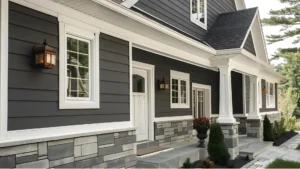
3. Fiber cement siding

Fiber cement is a board made of cement, sand and cellulose fiber, sold as lap planks, panels, shingles and trim. James Hardie is the brand most people know. The manufacturer states that its siding complies with ASTM E136 as a noncombustible cladding and that the fire performance does not extend to applied paints or coatings, which is a useful distinction to remember when a supplier says “Class A.”
| Pros | Cons |
|---|---|
| Noncombustible material (ASTM E136), which satisfies the wildfire code’s exterior wall covering options directly | Heavier and more expensive to install than vinyl; cutting it releases silica dust, so it is a job for trained crews |
| Holds paint well; prefinished options available | The paint film is the maintenance item: plan for a repaint cycle |
| Does not rot and is not food for termites | Can chip on a sharp impact; cut edges must be sealed |
Best for: homeowners who want a painted, architectural look that lasts, and anyone re-siding in a fire hazard zone. If the real choice is between this and the cheapest option, our fiber cement vs vinyl siding comparison goes deeper.
On a fiber cement siding and painting project in Auburn, Good Life Construction removed the existing stucco down to the framing, installed sheathing and building paper, then about 2,200 square feet of James Hardie lap and board-and-batten siding with hot-dipped galvanized fasteners, Hardie trim and metal flashing at transitions, and painted it as the final step. The whole project, which also included stripping interior plaster down to the framing, came in at about $38,000 over four weeks. The order matters more than the brand: the sheathing and the barrier behind the siding are what keep the wall dry.
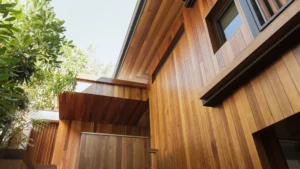
4. Wood siding
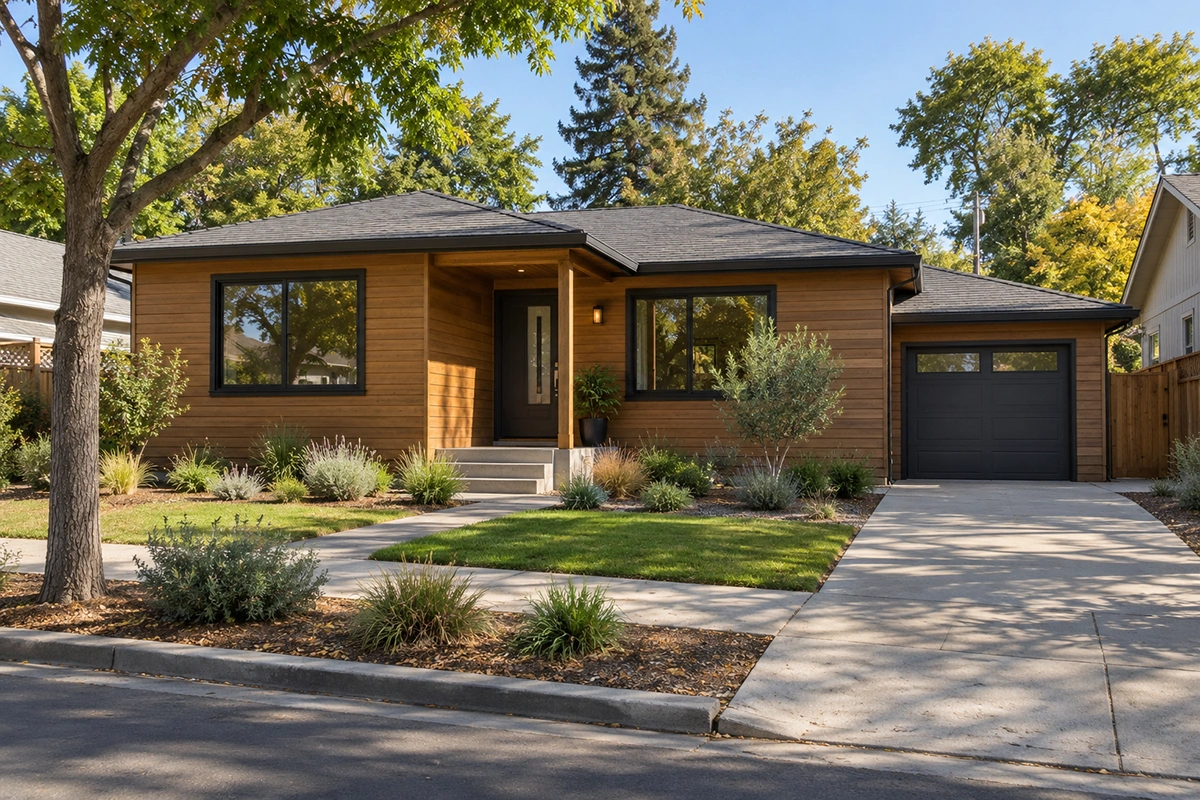
Cedar, redwood and pine siding give a warmth nothing else quite matches. They also ask the most of an owner.
| Pros | Cons |
|---|---|
| Natural appearance; can be painted or stained any color | Needs regular sealing, staining or painting |
| Repairable board by board | Vulnerable to rot, termites and sun if the finish lapses |
| Renewable material | Combustible; in a fire hazard zone it needs a qualifying assembly behind it |
Best for: owners who love the look and will keep up with it, or as accents. See vinyl siding vs wood siding for the full maintenance comparison..
5. Metal siding
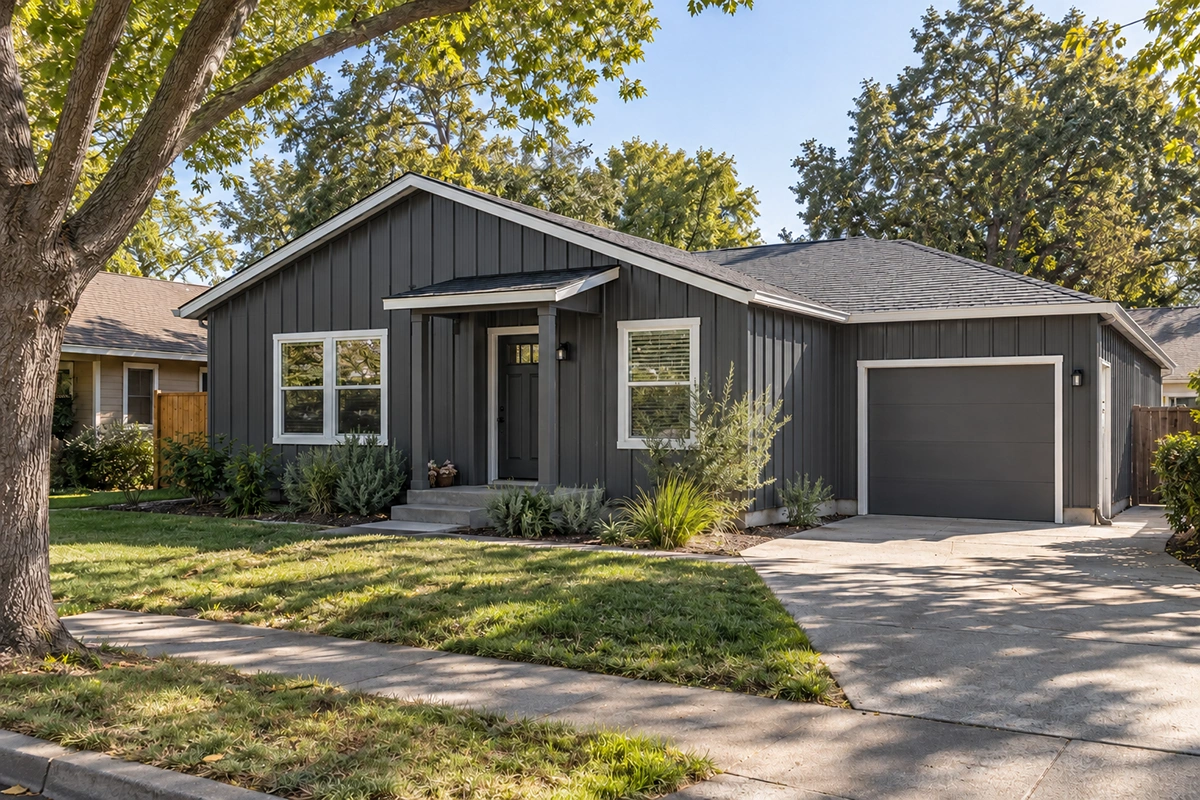
Steel and aluminum siding, in corrugated or flat profiles, suit modern designs and outbuildings.
| Pros | Cons |
|---|---|
| Noncombustible material; does not rot and pests ignore it | Dents and scratches; dark colors get very hot in the sun |
| Low routine maintenance | Limited profile and texture choices for traditional homes |
| Long life when the coating holds | Needs careful flashing and isolation from dissimilar metals |
Best for: modern or industrial styles, accent walls and detached structures.
6. Vinyl siding

Vinyl is a rigid PVC cladding in many colors and textures, including wood-grain and insulated panels.
| Pros | Cons |
|---|---|
| Lowest installed cost and fastest to install | Combustible; softens and deforms at temperatures other materials tolerate |
| No painting; wash it and replace damaged panels | Expands and contracts with heat, so it buckles if nailed tight |
| Does not rot | Fades and gets brittle over time on sun-beaten south and west walls |
Best for: budget and low-maintenance priorities, rentals and quick exterior refreshes. How it goes on decides how it lasts; see how vinyl siding should be installed.
What about engineered wood siding?
Engineered wood lap and panel siding shows up in many national comparisons, so it is worth knowing where it fits. LP SmartSide is a common brand. Its ICC-ES evaluation report ESR-1301 describes a mat-formed wood substrate treated with a zinc borate preservative, a resin-impregnated overlay on the face exposed to weather, and factory-sealed edges, and it lists the siding for buildings where combustible materials are permitted. In practice it sits between wood and fiber cement: it is painted like wood and the paint film needs keeping up, and because it is a combustible cladding, in a fire hazard zone it follows the same qualifying-wall-assembly path as wood and T1-11.
If your parcel is in a fire hazard severity zone, the list gets shorter
This is the part of the decision that changed most recently.
What changed. The 2025 edition of the California Building Standards Code took effect on January 1, 2026, and for the first time it includes a stand-alone Part 7, the California Wildland-Urban Interface Code. An emergency supplement, effective the same day, widened where it applies. Its application section now covers new buildings in State Responsibility Areas, in Local Responsibility Area lands the State Fire Marshal has identified as High and Very High Fire Hazard Severity Zones, and in High, Very High and wildland-urban interface areas designated by cities and counties.
Why it may reach your house. The Office of the State Fire Marshal rebuilt the maps. The Fire Hazard Severity Zones page explains that zones are classed Moderate, High or Very High; that the State Responsibility Area maps took effect in April 2024; and that the Local Responsibility Area maps were released in four phases between February 10 and March 24, 2025. The page tells homeowners to contact their local jurisdiction for information on a specific area. Look your address up on the viewer linked from that page, then confirm with the building department that issues your permit.
What the code says about exterior walls. Section 504.5 of the Wildland-Urban Interface Code lists the ways an exterior wall can comply: one-hour fire-resistance-rated construction on the exterior side; noncombustible materials; heavy timber; log wall construction; wall assemblies that pass the ASTM E2707 or SFM Standard 12-7A-1 direct-flame tests; assemblies with one layer of 5/8-inch Type X gypsum sheathing applied behind the exterior covering; one-hour rated assemblies tested from the exterior; or fire-retardant-treated wood labeled for exterior use. Alternatively, the wall can be covered with an exterior wall covering that is itself noncombustible, ignition-resistant and labeled for exterior use, or fire-retardant-treated wood. The covering has to run from the top of the foundation to the roof, and the code requires at least 6 inches of metal flashing or noncombustible material at ground, decking and roof intersections.
What that means for the six materials. Stucco and fiber cement get there most directly, because a cement finish and a board classified noncombustible under ASTM E136 fall inside the covering options on their own. Metal is noncombustible as a material, though the assembly behind it still has to be detailed. Vinyl, wood and T1-11 are combustible claddings, which does not ban them: the Type X gypsum sheathing path and the tested-assembly paths exist precisely so a combustible covering can sit on a qualifying wall. That path is an assembly you design and detail, not a product you buy, and your building department has to accept it. Ask before you order material.
If you are not re-siding the whole house. The University of Nevada, Reno Extension’s Wildfire Home Retrofit Guide (SP-20-11) points to where combustible siding is most exposed: where a lower roof meets a wall, where embers and debris collect, and where siding runs down to the ground. Its advice is targeted. Replace the siding with a noncombustible product just at roof-to-wall intersections, which costs far less than re-siding the house. Run metal flashing at least 6 inches up the wall at those intersections. Favor noncombustible siding especially when neighboring homes stand within 30 feet. And do not count on fire-retardant paint over combustible siding, because weather degrades it and some codes do not accept it.
On existing houses. The code’s application section is written for new buildings, and it lists additions to and remodels of buildings originally constructed before July 1, 2008 among its exceptions. Whether replacing the cladding on your house is covered, and whether your city or county has adopted stricter local rules, is the building department’s call. That is the specific question to put to them before you choose.
One way to check a product. The State Fire Marshal’s Building Materials Listing program publishes a handbook of wildland-urban interface products its staff have verified against Chapter 7A. A listed product is a shorter conversation at plan check; an unlisted one is not automatically unusable.
What siding costs in the Sacramento area
Across the Sacramento market in 2026, replacement siding installed by a contractor, including tear-off of the old cladding, typically runs:
| Material | Installed cost per sq ft of wall |
|---|---|
| Vinyl | About $8 to $15 |
| Wood (lap, cedar, T1-11, engineered wood) | About $10 to $22 |
| Fiber cement | About $10 to $20 |
| Stucco (three-coat) | About $9 to $20 |
On a whole house, replacement typically runs $20,000 to $50,000, including removal, house wrap, flashing, trim and rot repair. Partial siding repairs on one or two elevations typically run $3,000 to $10,000. Two of our projects show the spread: the Auburn fiber cement re-side above came in at about $38,000, and a T1-11 replacement in Rancho Cordova that turned into framing repair (more on it below) came in at about $18,800.
The material is rarely the biggest driver. Tear-off, rot found behind the old siding, height and staging, the trim and flashing detail at windows and roof lines, and paint move a quote more than the line item for siding. Our siding repair cost guide breaks those drivers down.
Siding options by what you care about most
| If your priority is | Lean toward | Watch out for |
|---|---|---|
| Lowest installed cost | Vinyl, then T1-11 | T1-11’s lifetime of painting |
| Lowest cost to own over 15 years | Vinyl or factory-finished fiber cement | Sun exposure on vinyl |
| Longest life | Fiber cement, stucco, metal | Paint cycles and repair color-matching |
| Fire hazard zone compliance | Fiber cement, stucco, metal | Combustible claddings need a qualifying assembly |
| Looks | Wood, fiber cement | Wood’s upkeep |
| Low maintenance | Vinyl, metal, fiber cement | None are zero-maintenance; flashing and caulk still need checks |
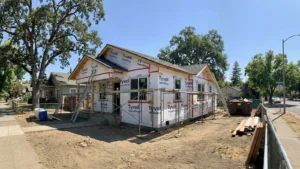
Whichever material you pick, the wall behind it decides the outcome. The California Residential Code requires a water-resistive barrier behind exterior wall coverings and flashing at openings and roof-to-wall intersections, and that is the layer no one sees in the finished photos. Our guide to Tyvek house wrap explains what it does. A siding quote that does not describe the barrier, the flashing and an allowance for damage found underneath is not a complete quote. On a siding replacement in Rancho Cordova, what started as T1-11 panel replacement turned into framing repair once the old siding came off and dry rot was found; the framing was rebuilt, pressure-treated wood went in at the base, flashing and a weather-resistant barrier were added, and the new siding was held clear of the soil. That is a normal re-side on an older house, not a surprise. If your siding is damaged rather than worn out everywhere, siding repair vs replacement covers when a partial repair is enough.
Frequently asked questions
What is the most durable siding for a house?
Fiber cement, stucco and metal last the longest with the least structural upkeep. Fiber cement and stucco carry a paint film you repaint on a cycle; metal depends on its coating. The James Hardie product page describes a 30-year limited substrate warranty on its siding; the exact terms are on the manufacturer’s site.
What is the best house siding for the money?
It depends which cost you mean. T1-11 is usually the lowest material cost. Vinyl, at about $8 to $15 per square foot of wall installed in the Sacramento market, is usually the lowest installed cost and often the lowest cost to own, because it needs no painting or sealing while T1-11 needs both for its whole life. If you mean the most years for each dollar, price vinyl against factory-finished fiber cement for your own walls, as the comparison table above suggests.
What is the cheapest siding option overall?
For installed cost, vinyl. For material alone, T1-11 is often lower, but it is the cheaper purchase and the more expensive decade.
What is the most low-maintenance siding?
Vinyl, metal and fiber cement. None is maintenance-free: caulk joints, flashing and penetrations need a look every year on every material.
What is a better option than vinyl siding?
That depends on what you want to fix. If the problem is heat, such as warping or fading on a south or west wall, fiber cement and stucco handle sun better. If it is the look, fiber cement and wood give a painted or natural finish vinyl cannot. If your parcel is in a mapped fire hazard zone, fiber cement, stucco and metal reach the wildfire code’s wall options most directly. Vinyl still wins on installed cost, so the change pays off only when one of those reasons applies to your house.
What is the best siding for a California home?
For most houses in the Sacramento Valley and the foothills, fiber cement and stucco. Both handle long, hot summers without warping, and both are noncombustible, which matters if your parcel is in a mapped fire hazard zone. Vinyl is a reasonable budget choice on a valley-floor house outside a mapped zone, as long as it is installed with the clearances it needs for heat.
Which siding is best for energy efficiency?
None of them is an insulator by itself. Energy performance comes from the insulation, air sealing and water-resistive barrier behind the cladding. Insulated vinyl adds a thin foam layer that helps on an under-insulated wall; on a well-insulated wall the difference is comfort at the surface more than a lower bill.
Talk to us about your siding
Good Life Construction is a licensed general contractor (CSLB #979670, classification B – General Building) serving the Sacramento region since 2009. We install and replace fiber cement, stucco, vinyl, wood and T1-11 siding, and because we hold a general building classification, the dry rot repair, framing and flashing work that turns up behind old siding is handled by the same crew. If you are weighing materials, or you want to know what your fire hazard zone means for the list, contact us or call (916) 833-1379 and we will look at the house with you.